
A backup is a hypothesis. A restore is proof.


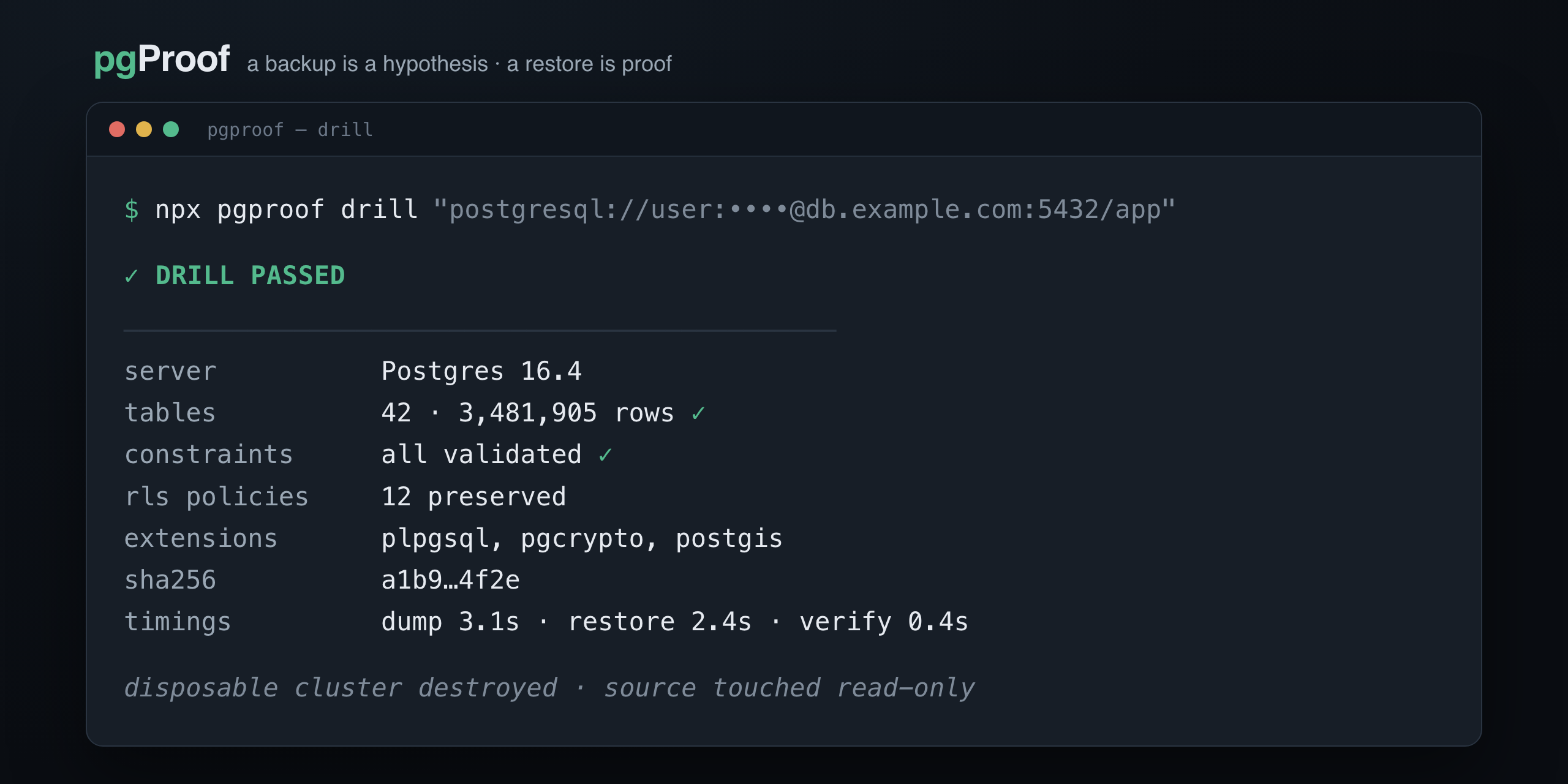
pgproof dumps your Postgres database, restores the dump into a disposable
local cluster, and verifies the result: table and row counts against a
manifest captured at dump time, foreign-key constraints, sequences,
extensions, RLS policies, and your own probe queries. Then it destroys the
evidence and tells you the truth — in seconds, without Docker.
npx pgproof drill "$DATABASE_URL"
Works with Supabase (use the Session Pooler string), Neon (use the direct, non-pooled string), Railway, Render, RDS, and self-hosted Postgres 13–17.
Every restore disaster starts with months of dumps that "worked". Truncated
uploads, missing extensions, version mismatches and silently-empty tables all
look identical in a bucket listing. The only proof is a restore — so pgproof
does one, every time, in seconds, without Docker and without touching your
source database beyond a read.
npm install -g pgproof # or: npx pgproof …
Requires Node ≥ 20 and local Postgres client/server binaries at a version ≥
your database's major (Postgres.app, Homebrew, or apt postgresql-N all
work; auto-discovered, or point PGPROOF_PG_BIN at a bin directory).
# full drill: dump + restore + verify
pgproof drill "$DATABASE_URL"

# keep the (verified) dump — this is your backup now
pgproof drill "$DATABASE_URL" --keep --out backups/today.dump

# verify a RECENT backup file against the live database's manifest
pgproof drill "$DATABASE_URL" --file backups/today.dump

# verify an OLD ARCHIVE with no live source (or one that changed since):
# restores it, validates constraints, runs probes, reports what it contains
pgproof verify backups/2026-07-01.dump --probe "SELECT count(*) > 0 FROM clients"

# domain probes: prove the data is not just present but sane
pgproof drill "$DATABASE_URL" \
  --probe "SELECT count(*) > 0 FROM users" \
  --probe "SELECT max(created_at) > now() - interval '7 days' FROM orders"

# machine-readable, for CI
pgproof drill "$DATABASE_URL" --json
Exit codes: 0 drill passed · 1 drill failed · 2 could not run.
- Restore completes with
--exit-on-errorin a throwaway cluster built with version-matched tools (never older than the source). - Manifest match: every table present, exact row counts equal, no unexpected tables, sequences and extensions present, RLS policy count not lower.
- Constraints: zero
pg_constraintrows left unvalidated. - Your probes: each query must return a truthy first column.
- sha256 of the dump, so a truncated upload can never impersonate a verified backup.
pgproof proves one backup when you run it. pgproof.com
runs the schedule for you: encrypted storage, a drill on every backup,
immediate alerts on failure, and a weekly proof report — for Supabase, Neon,
Railway, Render and self-hosted (agent mode: your credentials never leave
your box). Currently in private beta — join the waitlist.
AGPL-3.0-only. The CLI is free forever; if you offer it as a service, your service must be open too.