For incident investigators and safety teams who need to prove a robot/autonomy log wasn't altered after the fact.
A CLI that seals a robot/autonomy log (MCAP) with an Ed25519 signature and a Bitcoin timestamp (OpenTimestamps), producing a .seal.json manifest. A disinterested party can later prove "this log matches a seal made by key K, anchored at time T", but only if the verifier pins the signer's key (--pubkey). Without key pinning, a tampered re-seal with a new key still passes.
Status: early v0.1, solo project: seal/verify/inspect/pack work end-to-end, but APIs may change. Adversarial feedback welcome: open an issue.

Not on PyPI yet. Install directly from GitHub:
pip install git+https://github.com/kylemaps/verisealOr for development:
git clone https://github.com/kylemaps/veriseal.git
cd veriseal
pip install -e .# Generate a reusable signer key (and its public key, to share for pinning)
veriseal keygen --out signer.key.pem --pub signer.pub.pem
# Seal a log (submits Merkle root to OpenTimestamps by default)
veriseal seal log.mcap --key signer.key.pem --out log.seal.json
# Seal without OpenTimestamps, fast, fully offline
veriseal seal log.mcap --no-anchor --out log.seal.json
# Verify integrity (WARNING: without --pubkey the embedded key is trusted unconditionally)
veriseal verify log.mcap log.seal.json
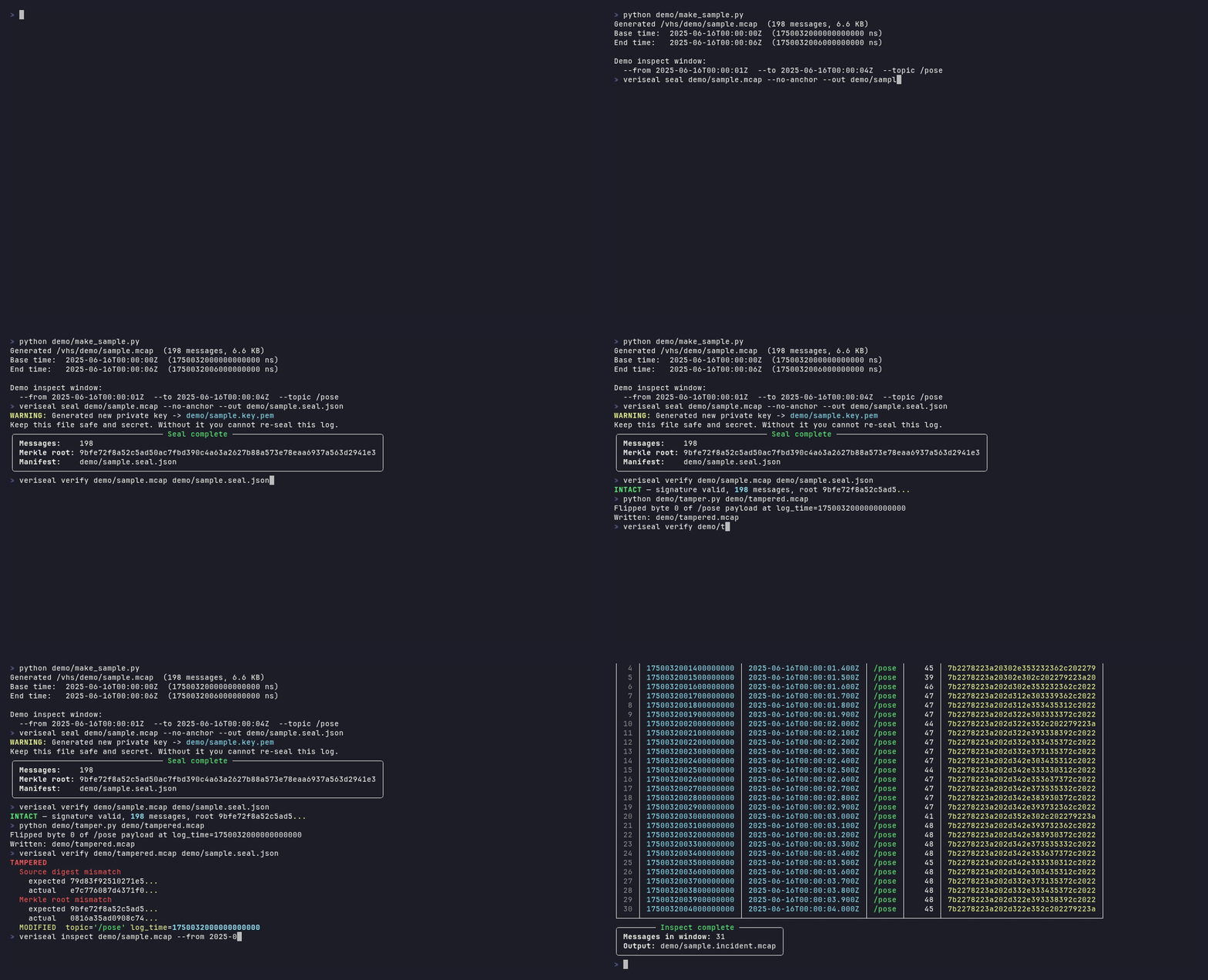
# INTACT: signature valid, 198 messages, root 9bfe72f8a52c5ad5...
# WARNING: no --pubkey: trusting the key embedded in the manifest; ...
# Verify and pin the signer's key: the only way to catch a tampered re-seal
veriseal verify log.mcap log.seal.json --pubkey signer.pub.pem
# INTACT: signature valid, 198 messages, root 9bfe72f8a52c5ad5...
# Tamper detection: flip one byte inside a decoded message and re-verify.
# MCAP messages are chunk-compressed, so flipping a raw file byte usually
# breaks decompression outright rather than cleanly changing one message;
# decode first, flip, re-encode (see demo/tamper.py for the same approach).
python -c "
from mcap.reader import make_reader
from mcap.writer import Writer
rows, schemas, channels, flipped = [], {}, {}, False
with open('log.mcap', 'rb') as f:
rows = list(make_reader(f).iter_messages())
with open('tampered.mcap', 'wb') as f:
w = Writer(f); w.start()
for sc, ch, m in rows:
schemas.setdefault(ch.schema_id, 0 if (sc is None or ch.schema_id == 0) else
w.register_schema(name=sc.name, encoding=sc.encoding, data=sc.data))
channels.setdefault(ch.id, w.register_channel(
topic=ch.topic, message_encoding=ch.message_encoding,
schema_id=schemas[ch.schema_id], metadata=ch.metadata))
data = m.data
if ch.topic == '/pose' and not flipped:
data, flipped = bytes([m.data[0] ^ 0xFF]) + m.data[1:], True
w.add_message(channel_id=channels[ch.id], log_time=m.log_time,
data=data, publish_time=m.publish_time, sequence=m.sequence)
w.finish()
"
veriseal verify tampered.mcap log.seal.json --pubkey signer.pub.pem
# TAMPERED
# Source digest mismatch
# expected 79d83f92510271e5...
# actual 5e73e3ba4abc6267...
# Merkle root mismatch
# expected 9bfe72f8a52c5ad5...
# actual 0816a35ad0908c74...
# MODIFIED topic='/pose' log_time=1750032000000000000
# Inspect an incident time-window (ISO-8601 or nanoseconds since epoch)
veriseal inspect log.mcap \
--from 2025-06-16T00:00:01Z \
--to 2025-06-16T00:00:04Z \
--topic /pose
# Export window as a new MCAP (openable in Foxglove Studio)
veriseal inspect log.mcap \
--from 2025-06-16T00:00:01Z \
--to 2025-06-16T00:00:04Z \
--out incident.mcap
# Build a portable, independently re-verifiable incident-evidence bundle
veriseal pack log.mcap log.seal.json --out incident-pack/
veriseal pack log.mcap log.seal.json --out incident-pack --zip # single .zip to hand off
# Later, check whether a pending Bitcoin timestamp has been confirmed
veriseal anchor upgrade log.seal.jsonBy default, veriseal seal submits the signed Merkle root to public Bitcoin calendar servers (OpenTimestamps). The embedded proof starts as status: "pending" and becomes "confirmed" once a Bitcoin block includes the Merkle path (typically a few hours later).
To pull that confirmation into the manifest once it lands, run veriseal anchor upgrade log.seal.json: it asks the calendars whether the proof is now in a Bitcoin block and, if so, updates the anchor block in place (status -> confirmed, block height recorded). The anchor is excluded from the signed payload, so this never invalidates the signature. It never records a confirmation the proof does not actually carry.
veriseal verify reports anchor status informational: the INTACT/TAMPERED verdict and exit code are unaffected by anchor state unless --require-anchor is set:
INTACT: signature valid, 198 messages, root 9bfe72f8a52c5ad5...
  Anchor: pending (not yet Bitcoin-confirmed)
Skip anchoring for offline workflows or CI:
veriseal seal log.mcap --no-anchorRequire a valid anchor (useful in audit pipelines):
veriseal verify log.mcap log.seal.json --pubkey signer.pub.pem --require-anchorAdd one step to your ROS 2 recording workflow so every log is sealed the moment it finishes: generate a signer key once with veriseal keygen, then run veriseal seal on the recorder's exit (a post-record one-liner, or an OnProcessExit handler in a launch file). Copy-paste snippets: docs/auto-seal.md.
veriseal hashes (topic, log_time, payload) message triples, which aren't MCAP-specific. It seals MCAP natively and ROS 1 .bag directly via the optional rosbags reader (pure Python, no ROS install): pip install "veriseal[ros1]", then veriseal seal drive.bag .... seal, verify, and pack work the same across formats (the manifest records source.format); inspect's window export is MCAP-only. See docs/ros1.md.
The whole point of the seal is that someone who trusts neither the operator nor veriseal can still check it. web/verify.html is a single self-contained page that does exactly that: drop an .mcap and its .seal.json, and it recomputes the Ed25519 signature, the RFC 6962 Merkle root, and the SHA-256 file digest entirely in the browser (WebCrypto, no network calls, nothing uploaded). To reach a green VERIFIED it also asks you to paste the signer's expected public key (obtained out-of-band) and pins it; without a pinned key the result stays amber, since the embedded key alone proves nothing about who signed. Open the file locally, or host it anywhere static. An insurer or investigator can verify a sealed log on their own machine without installing anything.
veriseal-panel/ is a Foxglove Studio extension that checks a seal in-workflow, without leaving your visualization. Open a log, load its .seal.json, and a live badge reports SIGNER VERIFIED (when you pin the signer's key), AUTHENTICITY NOT ESTABLISHED (signature + Merkle valid but no key pinned), or MANIFEST INVALID — verifying the signature and Merkle root against the signer's Ed25519 key. (Whole-file byte integrity stays the CLI/web-verifier's job, since a panel only sees decoded messages, never the raw file bytes.) The panel's verification core is the same logic as the web verifier and is tested against the Python reference.
veriseal pack bundles an already-sealed log into a portable, self-contained evidence package: the manifest, a plain-English verification report, the OpenTimestamps proof (if any, with its honest pending/confirmed state), an offline copy of the web verifier, and a cover sheet explaining what the seal proves — and doesn't. It re-runs the exact same verification veriseal verify performs (one code path, two renderings), so the report can never drift from what the CLI would say.
veriseal pack log.mcap log.seal.json --out incident-pack/        # a directory
veriseal pack log.mcap log.seal.json --out incident-pack --zip    # a single .zip to hand off
The pack is evidence infrastructure, not a compliance certificate: it supports disclosure obligations under things like the EU Product Liability Directive (2024/2853) or AI Act Article 73 by making a log's integrity independently checkable, but it never asserts the log's contents are true, and it never claims to satisfy any regulation on its own.
What it PROVES: this log matches a seal made by key K at time T. "Independently verifiable" requires two things: (1) the verifier knows and pins the signer's public key (--pubkey); (2) the anchor is trusted. Without --pubkey, a tampered re-seal with a fresh key still passes. Without the anchor, time claims rest only on the sealer's assertion.
What it does NOT prove: that the log is a truthful record of physical reality at capture time. A seal cannot un-fabricate data captured falsely. Integrity ≠ veracity.
Where neutrality actually comes from: sealing as early as possible (ideally at/near capture) and anchoring the root in a public append-only log, so no single party (including the custodian) can backdate or alter it. The closer the seal is to capture and the more public the anchor, the more "neutral" the evidence.
Content vs bytes:
verifychecks message content, not file bytes: a losslessly re-muxed MCAP with identical messages still verifies INTACT.source.sha256is the separate strict byte-level check, reported alongside the Merkle result.
- Hash: each MCAP message is domain-separated and SHA-256 hashed:
SHA-256(b"\x00" + b"veriseal-leaf-v1\x00" + len(topic) + topic + log_time + payload). - Merkle tree: leaves sorted by
(log_time, topic, leaf_hash)and combined with the RFC 6962 binary Merkle Tree Hash algorithm. Any single-byte change flips the root; the leaf diff pinpoints the affected (topic, log_time) group. - Sign: the manifest (root + all leaves + metadata) is serialized as canonical JSON and signed with Ed25519. The signer's public key is embedded in the manifest.
- Anchor: the signed manifest is SHA-256 hashed and submitted to OpenTimestamps public calendars. A Bitcoin block later commits to it, providing a trustless timestamp no single party (including the sealer) can backdate.
The .seal.json format is fully documented in SPEC-manifest.md: a conforming verifier needs only that document, the MCAP, and standard crypto libraries.
seal     ingest MCAP → hash every message → RFC 6962 Merkle tree →
         sign manifest (Ed25519) → anchor root (OpenTimestamps/Bitcoin) → *.seal.json

verify   recompute Merkle tree from MCAP → check signature → compare roots →
         INTACT or TAMPERED (locate modified/added/removed messages)
         informational: anchor status (pending / confirmed / invalid)
         optional: --pubkey to pin the signer's key, --require-anchor to enforce anchor

inspect  filter MCAP to time window → print chronological event timeline →
         export window as incident.mcap (openable in Foxglove Studio)
- v0.1: seal / verify / inspect / pack on MCAP + OpenTimestamps anchor; independent web verifier; Foxglove panel
- v0.2: chain-of-custody log; RFC 3161 + Sigstore/Rekor option; ROS 2 bag ingest; HTML report
- v0.3: web viewer; sealing daemon; pluggable transparency-log backend
Apache-2.0 © Kyle Mapue