
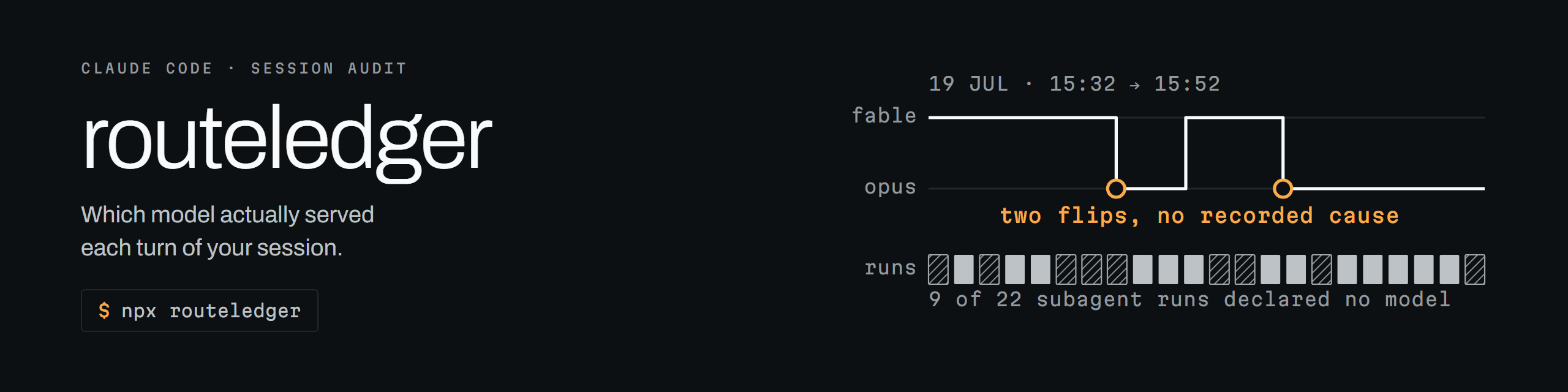


Which model actually served each turn of your Claude Code session — and where the routing quietly diverged from what you configured.
Claude Code picks the model for a turn from a stack of inputs: the model setting, the plan-mode boundary, ANTHROPIC_DEFAULT_* alias overrides, subagent frontmatter, CLAUDE_CODE_SUBAGENT_MODEL, allowlist substitutions, fallback chains, and automatic safety fallback. Most of them can change what you get without raising an error. You keep working; the answers keep coming; the model is not the one you configured.
Your session transcript already recorded what happened. routeledger reads it.
npx routeledger
Real output, from a real session (abridged — the full report lists all twelve flagged findings):
routeledger — session da6e9010-343d-4966-a90c-7a7de1af0825
  project: C--Users-onuri-Hezarfen-Vault
  claude code: 2.1.206, 2.1.207, 2.1.211, 2.1.218, 2.1.220

  MODELS SERVED
    claude-opus-4-8                7589 turns
    claude-fable-5                 3809 turns

  FINDINGS
    [OBSERVATION ] unexplained model change
                    claude-fable-5 -> claude-opus-4-8 @ 2026-07-19T15:32:10.329Z
                    inference: no user action found; but a mid-session settings.json
                    edit and a resume are not recorded in the transcript, so this is
                    a hypothesis
    [OBSERVATION ] plan-mode profile
                    plan: claude-fable-5 | execution: claude-fable-5, claude-opus-4-8
                    inference: claude-fable-5 served turns on both sides of the
                    plan-mode boundary; if you expected a plan-mode upgrade, it
                    may never have fired. The configuration at session time is not
                    recorded in the transcript, so this is an observation, not a
                    verdict
    [UNVERIFIABLE] agent-a90c8e85777de7dde (general-purpose)
                    no declared model; served: claude-fable-5, claude-opus-4-8
    [OK          ] 20 findings raised nothing
                    to see each of them: routeledger --all
Two things in that report are invisible everywhere else: a model change nobody asked for, and a single subagent run served by two different models.
routeledger               audit the most recent session
routeledger <session-id>  audit a specific session (a prefix is enough)
routeledger --sessions    list recent sessions, newest first, to pick an id from
routeledger --all         list matching findings individually instead of summarising them
routeledger --json        print the report as JSON (always includes every finding)
Requires Node 20+ and Claude Code transcripts under ~/.claude/projects.
1. Subagent: declared model vs served model. Every subagent run leaves a meta.json recording the model it was asked for, next to a transcript recording the model that answered. routeledger joins them. Limit: when meta.json declares no model, there is no recorded intent to compare against, so the finding is unverifiable — not "fine".
2. Model changes inside a session. Walks the served model across the session and separates changes you asked for from changes you did not, by looking for a preceding /model command. Limit: "no user action found" is an inference, not a finding. A mid-session settings.json edit and a resume are not recorded in the transcript. routeledger labels this on every such report rather than presenting it as a verdict.
3. Plan mode profile. Reports which models served plan-mode turns versus the rest. If they are identical and you expected a plan-mode upgrade, it may not have fired. Limit: the configuration in force at session time is not recorded, so this is an observation, never a judgement.
- No network. Ever. There is nothing to configure and nothing to opt out of.
- Writes nothing. No files, no cache, no telemetry. Read-only by construction.
- Changes nothing. It cannot switch models or touch your configuration.
- Does not report message content. Your prompts and Claude's replies are never printed, stored, or transmitted. One narrow exception, stated plainly because "it does not read your content" would be false: check 2 scans user text in memory for the
/modelcommand marker, so it can tell a change you requested from one you did not. That text never enters a finding and never leaves the process.
The Claude Code transcript format is undocumented and it moves. During development a single transcript was found spanning five CLI versions, and a record type present in one session was absent in another.
routeledger records the Claude Code version behind every session it reads. On a version newer than the last one it was verified against — or when no version was recorded at all — it refuses to assert: every finding degrades to unverifiable (the withdrawn claim is kept in the detail line), and the models-served table is labeled as a raw, unverified count. An auditor that is confidently wrong is worse than no auditor.
- The environment a session ran with —
ANTHROPIC_DEFAULT_OPUS_MODELand friends — is not recorded as structured data anywhere in the transcript. routeledger therefore cannot prove that an alias remap was intended, or that one silently went missing on resume. It will not guess. (Those variable names can turn up inside a transcript as ordinary conversation text, because someone discussed them. That is not a record of the environment, and routeledger does not read it as one.) unverifiableis a real answer here and appears often. It means the evidence needed is absent, not that everything is fine.- Findings describe one session. There is no history, no policy file, and no CI-gate mode in this version — findings never change the exit code. (The badge above is this repo's own test suite, not a gating feature.)
ccusage— what your sessions cost, broken down by model. Different question, and the one most people need first.tylerlaprade/fableplan— sets up a Fable-plans / Opus-executes routing. routeledger checks whether the routing you set up is the one you got.
Silent model substitution is an open, current problem. Claude Code's own tracker carries reports of opusplan falling back during plan mode with no signal, of classifier denials rerouting a request to a different model, and of subagent model attribution being displayed incorrectly after a fallback. In every case the work continues and nothing tells you.
The transcript on your disk already contains the answer. This reads it back to you.
MIT