


Bee My Honey is an economic simulation add-on for Minecraft Bedrock Edition. Using assets harvested by the world's hardworking bees, players can trade foreign currencies, invest in corporate equities, trade futures and physical commodities, take out loans, buy insurance, shop by mail order, work through a labor market, and keep an offline cold wallet.
→日本語訳はこちら
| Channel | Version | Notes |
|---|---|---|
| Stable | 0.4.5 | Recommended for regular worlds. Includes the 0.4.x features: bulk commodity trading, the Paws & Blackpots energy shop, the Fresh Market and food freshness (0.4.0-0.4.2), and loan management, account history, the daily quest board and dispatch to facilities (0.4.5). |
| Latest | 0.5.3 | Everything in 0.4.5, plus the 0.5.x features: villages and companies (corporate template, 0.5.1-0.5.2), village and company requests with weekly processing and factory processing (0.5.2), and bilingual names, loan requests between players, villages and companies, and money transfers (0.5.3). Features that first appear in 0.4.x are marked [0.4] below, and those that first appear in 0.5.x are marked [0.5]. |
See CHANGELOG.md for the full history.
Note for 0.4.x: the food freshness system (food rots in your inventory) is on by default in 0.4.x and cannot be switched off from in-game settings.
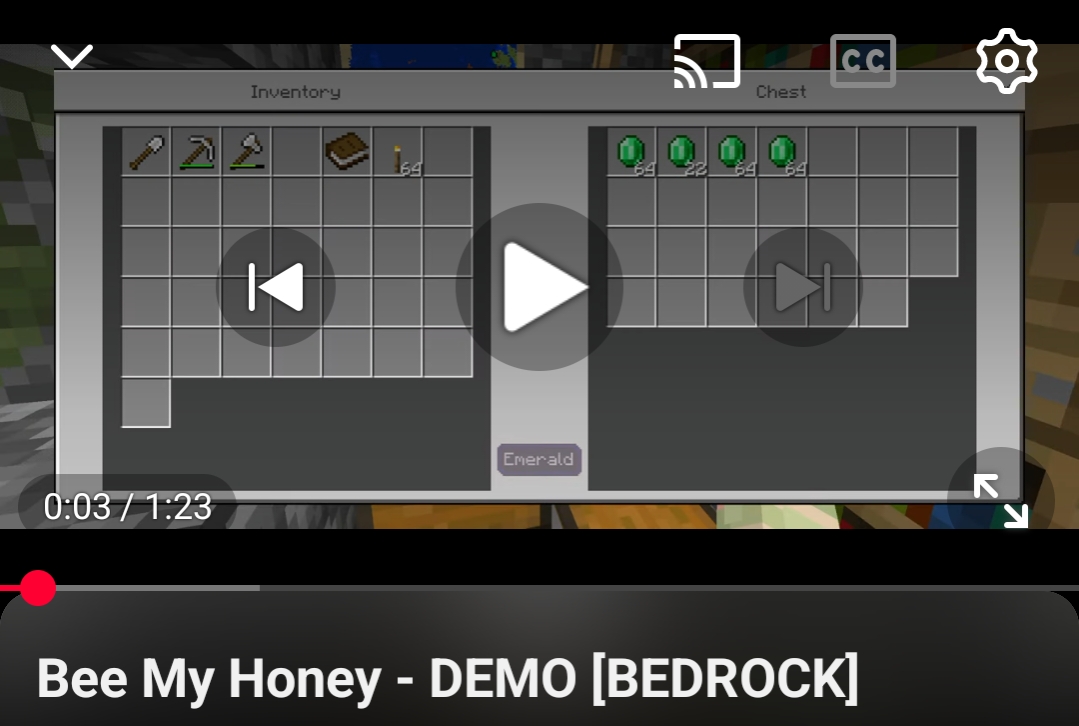
Interacting with a Bee Nest or Beehive while holding a book opens the Bee Exchange. Physical emeralds in your inventory are deposited into a digital account balance (E), which is used to trade currencies, stocks, futures and physical assets. Other services (insurance, mail order, labor market, animal trading and so on) are opened from specific blocks, listed below.
Hold a regular Book (minecraft:book) in your main hand unless noted otherwise, and interact (right-click or tap) with the block. "+ Flower Pot" means a flower pot (empty or planted) placed directly on top of the block; it keeps you from opening menus by accident.
| Service | Block | Notes |
|---|---|---|
| Bee Exchange (main menu) | Beehive | Bank, Forex, Stocks, Futures, Cold Wallet, Language |
| Bee trading (Honeycomb window) | Bee Nest | Trade with the bees |
| Physical assets (Golem) | Iron Block + Flower Pot | Diamond, gold, lapis, and more (see below) |
| Animal trading: Apple (APL) | Hay Bale + Flower Pot | Horse and Cat window. [0.4] also opens Paws & Blackpots |
| Animal trading: Sweet Berry (SWB) | Spruce Log + Flower Pot | Fox window |
| Animal trading: Glow Berry (GLB) | Moss Block + Flower Pot | Axolotl window. [0.4] also opens the Fresh Market |
| Animal trading: Chorus Fruit (CHO) | End Stone Bricks + Flower Pot | Dragon / Endermite / Shulker window |
| Insurance | Bone Block + Flower Pot | |
| Mail order (Skein) | Lectern, holding Paper | No flower pot needed |
| Labor market (HRMHRM Partners HLD) | Lectern, holding a Book | |
| Wandering Trader summon | White Wool + Flower Pot | Natural trader spawning is turned off; this is the only way to call one |
- Deposit physical emeralds into a digital balance (E), or withdraw the balance back into emeralds.
- All exchange instruments operate on this balance.
- Inventory overflow protection: if your inventory is full when withdrawing or collecting a dividend, the excess drops safely at your feet.
- The bank also links to the loan desk (see Loans & Credit Score).
- [0.4] Account History: the bank lists your last 30 deposits and withdrawals with the reason and, where known, the counterparty (for example "from HRMHRM Partners HLD").
Five currencies with different base rates and volatility:
- Honeycomb (HNY): Base currency. Reliable and steady.
- Apple (APL): Moderate, predictable wave patterns.
- Sweet Berry (SWB): Low cost per unit with high, sharp volatility.
- Glow Berry (GLB): Growth-oriented currency with upward potential.
- Chorus Fruit (CHO): Extreme volatility with aggressive spikes and drops.
Trade volumes can be adjusted with stepper buttons (+/-). When you add to an existing position, the average entry rate is calculated as a weighted average.
Eight fictional companies:
- Pupple (PPL): Smart collars and gadgets (Motif: Dog)
- McMoonald (MCD): Fast food and dairy milk (Motif: Cow)
- Witcha-Cola (WCC): Secret-formula potion drinks (Motif: Witch)
- Clattle (CLT): Skeletal defense and hardware (Motif: Skeleton)
- EekBay (EKB): Maritime express auctions (Motif: Dolphin)
- Skein (SKN): Jungle-parrot delivery giant (Motif: Parrot)
- KelpLife Holdings (KLH): Life insurer run by sea creatures (cash dividend)
- HRMHRM Partners HLD (HRM): Global consultancy that dispatches villagers (stock-option dividend)
Holding at least 100E in total valuation (share price × shares) of a stock qualifies you for one dividend per in-game day (world.getDay()):
- Pupple: Assorted cooked meat
- McMoonald: Pumpkin pies and a cake
- Witcha-Cola: Brewing materials (Nether Wart, Blaze Powder, Glistering Melon Slices, and more) and glass bottles
- Clattle: Bow, arrows and bone meal
- EekBay: A rare marine item (Nautilus Shell, Heart of the Sea or Prismarine Crystals)
- Skein: Sugar cane, redstone and nether quartz
- KelpLife Holdings: A cash dividend paid straight into your balance
- HRMHRM: Not claimed from the menu. Shares are granted as stock options each time the labor market generates work.
Five flower contracts (Rose, Allium, Jade Orchid, Sunflower, Sakura) with a two-day maturity window.
- Enter a long contract by posting a 5E margin deposit; you can hold multiple lots.
- Settle on or after the maturity date (two in-game days after entry).
- If the settlement price is above the strike, profit is credited. If it is below, the net loss is deducted.
- Default penalty: if a loss exceeds your balance, the balance is set to zero and security bees spawn to attack you.
The golem sells and buys physical goods, split into two categories:
- Rare resources (small-lot trading): Diamond, Gold, Lapis Lazuli, and [0.4] Nether Quartz and Redstone. Diamond/gold/lapis blocks count as 9 units each.
- General resources [0.4] (bulk trading, one Shulker Box per trade): Cobblestone, Iron, Copper, Glass, the eight log types, and Dirt, Sand, Gravel and Clay.
Bulk trades use shulker boxes placed as blocks within 6 blocks of you. To buy, have an empty shulker box placed nearby; the goods are delivered into it. To sell, have a shulker box placed nearby that is completely full of that one item. Each trade is limited to one shulker box (1,728 items).
Prices follow weekly patterns and are affected by demand pressure (see below). Bulk trades use a separate demand-pressure pool from small-lot trades.
Each foreign currency has its own animal window (see the table above). Sell items the animals like for that currency, and buy their goods with it. Currency-window purchases drop at your feet.
Open it from the Apple (APL) window: Hay Bale + Flower Pot, then the "Paws & Blackpots" button.
- Buys and sells Coal, Charcoal, Blaze Rods and Lava Buckets for APL, one item at a time.
- Real stock: the shop only has what is in its pool. Coal and charcoal restock daily (up to 100). Blaze rods and lava buckets do not restock once the starting stock is gone, and buying them requires the Nether license from the labor market.
- Prices follow "the shopkeeper cat's mood": a daily random multiplier. Pet the cat (once a day) or give it Cod/Salmon to improve its mood and get up to 25% off. Selling to the shop pays 60% of that day's asking price.
Open it from the Glow Berry (GLB) window: Moss Block + Flower Pot, then the "Fresh Market" button.
- A player-supplied order board for food, traded in GLB. It starts empty; goods appear only when players deliver them.
- Four genres: Seafood, Meat, Produce, Dairy & Eggs. Each item has its own page with a price chart and a list of anonymous listings (cheapest first).
- When you deliver, the game suggests a price range based on the region where you are (coastal, inland or remote), but you set the final price.
- Listed food loses freshness over time: the remaining quantity of a listing shrinks as it ages, and it disappears once it has fully spoiled.
Perishable food in your inventory (including the off-hand) slowly spoils and finally turns into Rotten Flesh.
- Raw food (fish, meat, milk, eggs, raw crops) lasts about 6 in-game days; cooked/processed food (cooked meat, bread, stews, baked potato, dried kelp) lasts about 12 in-game days.
- The timer starts when you pick the food up. Food stored in chests, barrels or shulker boxes does not age, and sleeping or changing the time does not speed it up.
- The item description shows "Freshness: XX%" and warns you before it is about to rot. Food obtained on the same day still stacks normally.
- Never spoil: sugar, honey items, potions, cake, cookies, pumpkin pie, golden apples, golden carrots, and the currency fruits (apple, sweet berries, glow berries, popped chorus fruit).
- Debug commands (need command permission):
/scriptevent bmh:food_infoshows held food and its age;/scriptevent bmh:food_age [days]fast-forwards held food.
- Five loan tiers. Higher tiers need a higher credit score and carry higher interest. You can borrow one loan at a time, and you can also lend one.
- The credit score (300-850) is shared by loans, the credit card, insurance and bankruptcy handling.
- Repayment, card billing and insurance premiums are handled at the weekly rollover.
- [0.4] Loan Management (Bank -> Loan Window): shows your borrowing and lending, and lets you repay early. With the toggle off you repay only the principal (the remaining interest follows the weekly schedule); with it on you repay everything and close the loan.
Marine (drowning), fishing-catch and undersea-asset policies, opened from Bone Block + Flower Pot. Marine insurance pays out on drowning deaths; the others pay a fixed amount on death.
Use a Lectern with Paper. Shop the catalog by category (fresh goods, household, redstone, gear, enchanted books, rare drops), with daily specials. Apply for a credit card with a limit based on your credit score, and pay with revolving installments (fixed minimum payment). A Prime-style subscription is available.
Use a Lectern with a Book.
- Staff Service: four quests are posted each day, the same for everyone (one per category; licensed categories are locked until you hold the license). Claim a quest, then select it again to deliver it by container or abandon it. A claim lasts until the end of the week, and you can hold 2 at a time by default. New players get a one-off "first part-time job" that gives a shulker box. [0.4]
- Licenses: Nether / Underwater / End licenses are earned by actually placing or breaking the relevant blocks in those places.
- Consultant Service: lease villagers.
- Owners' Club: register villagers as resumes and dispatch them to a facility (Farm / Mine / Factory; HRMHRM operates all three, and each company has its own virtual set [0.5]). The output is fixed when you sign the contract and is delivered to the facility's stock when you collect. A villager retires automatically after 3 years (1095 days) of total dispatch. 128 registered villagers maximum; accident risk rises above 100. [0.4]
- HRMHRM converts the stock above a set level into cash every week.
Hold a Glow Ink Sac and interact with a Bell to register a village (free) or a Lodestone to register a company (registration fee about 1,000,000 E, paid to HRMHRM; one company per player). Registered blocks are locked (they cannot be broken or blown up). Interact with the block for the management menu: Personnel / Accounting / Facilities / Inventory / Contracts / Management. A company is dissolved by liquidation (the bank buys its assets); a village is deregistered after weeks with no residents, and a company whose president has been away for a long time is dissolved automatically.
- Staff Service -> Village Quests: every day each village asks every player for 3 items (amounts depend on the village's population). Pick a village, choose an item and a quantity, then put the goods in a chest near the lectern and deliver. The village pays from its own funds, so it can only accept what it can afford. Items and amounts differ per player and per day.
- Staff Service -> Company Quests: companies post requests for raw materials they are short of (raw gold, diamonds, string).
- Villages process delivered goods weekly (bread, cooked meat, ingots, logs) and sell them below market. Companies own virtual Farm / Mine / Factory facilities (shown as dispatch destinations); a Factory only processes materials that are in stock.
- Real-area facilities ("Facilities" button) come in a later update.
- Besides bank loans, "Borrow" lets you post a request for a lender (no screening; the rate is higher for lower credit scores). Requests show up under "Lend"; when a lender takes one, the money arrives at once. Requests expire after about 7 days.
- Villages and companies that run short of funds post requests to the same board. If no one lends and their cash stays below the operating floor, they go into liquidation (forced dissolution).
- Dissolving a village returns its remaining cash to HRMHRM (outstanding loans are repaid to lenders first).
- Bank > "Send Money" sends emeralds to online players (2% fee on top, paid by the sender; 2,000 E (base) per day).
- You can borrow up to half your net assets and lend up to half your assets per loan. Villages and companies sell their stockpiled goods first and only request the remainder. Repaying a player-to-player loan does not raise your credit score. Transfers carry a 2% fee and a daily cap.
Encodes account Honeycomb into a story code of twenty keywords across five sentences. Codes can be shared on message boards, on notes, or imported into other worlds.
- Wallet creation: set a personal secret word to derive a public key (PK-XXXXXX).
- Export: withdraw Honeycomb into a code, in one of two themes ("Bees & Nature" or "Ores & Earth").
- Clipboard support: the result appears in a text field you can select and copy on any platform.
- Last code: review the last issued code any time from the wallet menu.
- Import: paste a code to redeem it. The parser ignores punctuation and filler words.
- Security: monotonic nonce tracking prevents replays, and a public-key-bound checksum signature is verified. The secret used for signing is generated per world; carrying a wallet into another world is an operator-only option.
White Wool + Flower Pot summons a Wandering Trader that is tethered to the spot (slowness applied and pulled back if it wanders off).
The economy runs on a seven-day cycle based on Minecraft world days.
- At the Day 7 → Day 1 rollover, market seeds refresh and new price trends begin.
- At rollover the "Weekly Bee News" is broadcast to chat with hints derived from currency and stock seeds.
- Demand pressure: the amount you buy or sell moves the price (up to ±60%), and the effect decays daily. It applies to forex, stocks and physical assets.
Full bilingual support for English and Japanese.
- The default language is detected from the player's client locale.
- Change it any time from the "Language" menu of the Bee Exchange.
- Add-on Name: Bee My Honey
- Version: 0.5.3 (stable: 0.4.5)
- Author: Melnus
- Target Platform: Minecraft Bedrock Edition (Script API supported environments)