
🌊 Fast and friendly ocean-flavored Julia software for simulating incompressible fluid dynamics in Cartesian and spherical shell domains on CPUs and GPUs. https://clima.github.io/OceananigansDocumentation/stable









Oceananigans is a fast, friendly, flexible software package for finite volume simulations of the nonhydrostatic and hydrostatic Boussinesq equations on CPUs and GPUs. It runs on GPUs (wow, fast!), though we believe Oceananigans makes the biggest waves with its ultra-flexible user interface that makes simple simulations easy, and complex, creative simulations possible. Oceananigans development is community-driven with contributors from academia and industry - see jobs discussions for developer and user opportunities! Testing infrastructure is provided by atdepth and the Climate Modeling Alliance.
- Contents
- Installation instructions
- Running your first model
- The Oceananigans knowledge base
- Citing and otherwise spreading the word
- Contributing
- Movies
- Performance benchmarks
Oceananigans is a registered Julia package. So to install it,
-
Download Julia (version 1.10 or later).
-
Launch Julia and type
julia> using Pkg

julia> Pkg.add("Oceananigans")
This installs the latest version that's compatible with your current environment. Don't forget to be careful 🏄 and check which Oceananigans you installed:
julia> Pkg.status("Oceananigans")Let's run a two-dimensional, horizontally-periodic simulation of turbulence using 128² finite volume cells for 4 non-dimensional time units:
using Oceananigans
grid = RectilinearGrid(CPU(), size=(128, 128), x=(0, 2π), y=(0, 2π), topology=(Periodic, Periodic, Flat))
model = NonhydrostaticModel(grid; advection=WENO())
ϵ(x, y) = 2rand() - 1
set!(model, u=ϵ, v=ϵ)
simulation = Simulation(model; Δt=0.01, stop_time=4)
run!(simulation)
But there's more: loading CUDA.jl (via using CUDA) and changing CPU() to GPU() makes this code run on a CUDA-enabled Nvidia GPU.
Dive into the documentation for more code examples and tutorials. Below, you'll find movies from GPU simulations and a link to our performance benchmarks.
It's deep and includes:
-
Documentation that provides
- example Oceananigans scripts,
- tutorials that describe key Oceananigans objects and functions,
- explanations of Oceananigans finite-volume-based numerical methods,
- details of the dynamical equations solved by Oceananigans models, and
- a library documenting all user-facing Oceananigans objects and functions.
-
Discussions on the Oceananigans github, covering topics like
- "Computational science", or how to science and set up numerical simulations in Oceananigans, and
- "Experimental features", which covers new and sparsely-documented features for those who like to live dangerously.
If you've got a question or something, anything! to talk about, don't hesitate to start a new discussion.
-
The Oceananigans wiki contains practical tips for getting started with Julia, accessing and using GPUs, and productive workflows when using Oceananigans.
-
The NumericalEarth slack where one may access institutional knowledge stored in the minds of the Oceananigans community!
-
Consider also joining the Julia Slack, yet another powerful community resource for the Julia package ecosystem, using GPUs, writing great Julia code, and hanging out.
-
Issues and pull requests also contain lots of information about problems we've found, solutions we're trying to implement, and dreams we're dreaming to make tomorrow better 🌈.
If you use Oceananigans for your research, teaching, or fun 🤩, everyone in our community will be grateful if you credit Oceananigans by name.
The community has published a number of articles describing the development of Oceananigans, including a recent preprint submitted to the Journal of Advances in Modeling Earth Systems that presents an overview of all the things that make Oceananigans unique:
"High-level, high-resolution ocean modeling at all scales with Oceananigans"
by Gregory L. Wagner, Simone Silvestri, Navid C. Constantinou, Ali Ramadhan, Jean-Michel Campin, Chris Hill, Tomas Chor, Jago Strong-Wright, Xin Kai Lee, Francis Poulin, Andre Souza, Keaton J. Burns, Siddhartha Bishnu, John Marshall, and Raffaele Ferrari
submitted to the Journal of Advances in Modeling Earth Systems, arXiv:2502.14148
bibtex
@article{Oceananigans-overview-paper-2025,
  title = {{High-level, high-resolution ocean modeling at all scales with Oceananigans}},
  author = {G. L. Wagner and S. Silvestri and N. C. Constantinou and A. Ramadhan and J.-M. Campin and C. Hill and T. Chor and J. Strong-Wright and X. K. Lee and F. Poulin and A. Souza and K. J. Burns and S. Bishnu and J. Marshall and R. Ferrari},
  journal = {arXiv preprint},
  year = {2025},
  archivePrefix = {arXiv},
  eprint = {2502.14148},
  doi = {10.48550/arXiv.2502.14148},
  notes = {submitted to the Journal of Advances in Modeling Earth Systems},
}
Please cite this 👆 overview paper if you use Oceananigans in published work.
We've also published/submitted several model development papers. Please cite these below 👇 if you use the features they describe! Also, if you have developed a new feature in Oceananigans and describe it in a paper, make sure to open a pull request to add it to this list:
-
Lee et al. (2026), "NORi: An ML-augmented ocean boundary layer parameterization".
This paper describes the development of NORi, a machine-learning-augmented parameterization for ocean boundary layer mixing, trained and validated using large eddy simulations with Oceananigans and tested in a centennial double-gyre simulation.
-
Silvestri et al. (2026), "A low-storage Runge-Kutta framework for nonlinear free-surface ocean models".
This paper describes the development of a Runge-Kutta timestepping scheme for the
HydrostaticFreeSurfaceModel. -
Moses et al. (2026), "DJ4Earth: Differentiable, and performance-portable Earth system modeling via program transformations".
This paper describes the development and advantages of a strategy that leverages Enzyme.jl and Reactant.jl for building differentiable Oceananigans workflows.
-
Silvestri et al. (2025), "A new WENO-Based momentum advection scheme for simulations of ocean mesoscale turbulence".
This paper describes the development of
WENOVectorInvariant()advection scheme, which can be used as themomentum_advectionscheme forHydrostaticFreeSurfaceModel. -
Silvestri et al. (2025), "A GPU-based ocean dynamic core for routine mesoscale-resolving climate simulations".
This paper describes the optimization of the
HydrostaticFreeSurfaceModelalgorithm, including the implementation of a newSplitExplicitFreeSurfacealgorithm forDistributedarchitectures for multiple GPUs. As a result of this work, global simulations with O(10 km) grid spacing can be run on 16-20 nodes, achieving 10 simulated years per day (SYPD). -
Wagner et al. (2025), "Formulation and calibration of CATKE, a one-equation parameterization for microscale ocean mixing".
This paper describes the development of
CATKEVerticalDiffusivity(), including how it was automatically calibrated to a suite of 35 large eddy simulations (also run with Oceananigans). It additionally features solutions fromTKEDissipationVerticalDiffusivity(also known as "k-epsilon"). -
Ramadhan et al. (2020), "Oceananigans.jl: Fast and friendly geophysical fluid dynamics on GPUs".
This article in the Journal of Open Source Software describes an early version of Oceananigans'
NonhydrostaticModel.
We also maintain a list of publications using Oceananigans.jl. If you have work using Oceananigans that you would like to have listed there, please open a pull request to add it or let us know!
If you're interested in contributing to the development of Oceananigans we want your help no matter how big or small a contribution you make! Cause we're all in this together.
If you'd like to work on a new feature, or if you're new to open source and want to crowd-source neat projects that fit your interests, you should start a discussion right away.
For more information check out our contributor's guide.
Click on a thumbnail to watch the movie on YouTube. Descriptions of these simulations, and more movies, can be found in the gallery and the examples of the documentation.
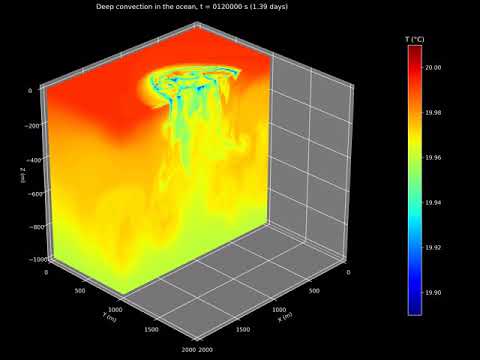
Deep convection |
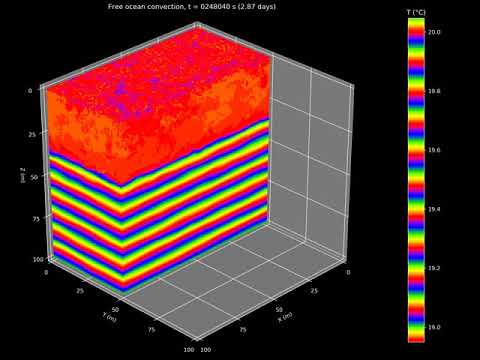
Free convection |
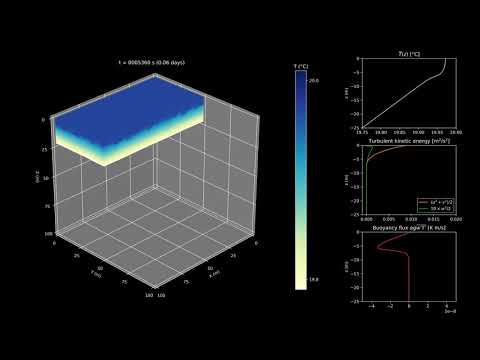
Winds blowing over the ocean |
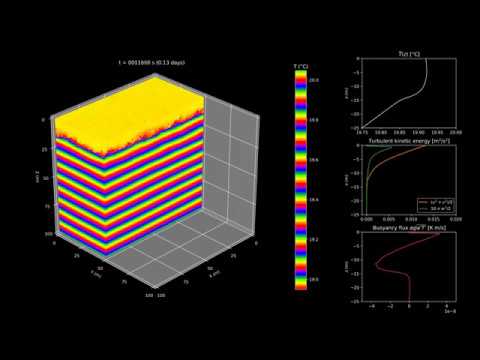
Free convection with wind stress |
We continuously measure the performance of Oceananigans by initializing models of various sizes with different schemes and closures
and measuring the wall clock time taken per model iteration (or time step).
These benchmarks are run on every commit to main and tracked on our performance dashboard.
For performance of large-scale, realistic ocean simulations on multiple GPUs, see Silvestri et al. (2025).